“I hope I may encourage readers to work on the many districts and counties that are still unexplored. Time is running out. The historical flow of change in the countryside – an erratic trickle with spates now and then – has turned since 1950 into a devouring flood, from which little,… is safe” To plan for the future we need to know about the origin and past maintenance of the details we now prize… Even if they fail in their objects, if they do their work properly, they will have the satisfaction of ensuring that the achievements of our past civilisation have not been allowed to perish unrecorded.” Oliver Rackham (1976)[1]
Introduction

This study aims to discover the medieval history of an area straddling the Herefordshire – Shropshire borders now known as the Mortimer Forest, 1086 and the accession of Henry Tudor in July 1483. This small pocket of woodland was once part of a complex landscape comprising woodland, wood pasture and farmland, some of which was reserved for farming and hunting deer.
Uncovering the medieval history of an area has its challenges. Records are scattered through a plethora of primary sources, some are lost and others incomplete. The Domesday Book, provides details of landholders, tenants and land use in 1086. From this point onwards all the chief Lords of England held their lands of the king, so central records were developed to aid the king in collection taxes, confiscating and allocating lands. The chief lords reserved demesne lands for themselves and rented the rest to minor nobles or knights, in return for knight’s service. Freemen and peasants would rent smaller parcels and have access to common pastures, in exchange for Lord’s service. Many tenants also paid rent either in cash or by token[2].
The Mortimer Forest and its immediate environs were not part of Royal Forest, uncultivated or heavily wooded districts with poor soil taken by the king as his private hunting grounds, until the accession of Edward IV in 1461[3]. Although the legal system for implementing Forest Law, was much diminished by then.[4]. However the king forbade private landholders to hunt wild deer, boar, and game or take raptors on their lands, without specific licences, as he had deemed these birds and beasts his property[5]. Forest Law was independent of common and ecclesiastical law, its implementation solely depended on the will of the king and the Justice of the Forests. A network of often corrupt forest officials managed the woodlands and identified miscreants who were presented to the triennial Forest Eyres[6]. Despite the issue of the Charter of the Forest in 1217, and promises of reform made by Henry III and his descendants, medieval kings continued to apply it according to their whims until its slow demise from the mid-14th century onwards.
The Wigmore Surveys of 1325 and 1325, translated by Lovelace, provide an insight into the design and uses of medieval deer parks in the locality[7]. These parks provided wood pasture, common grazing, and oaks, for timber[8]. It is likely that equivalent parks at Burford, Wooferton and Richard’s Castle[9] were similar in design and use. This survey also explored the use of the Chases, Bringewood, Mocktree and Deerfold, private hunting forests with arbitrary borders. It therefore provides valuable information about the relationships between neighbouring Lords and between Lords and their tenants.
The study will be organised on the following themes:
- Changes to Land Use Over Time
- The People of the Area and Their Relationships to Each Other
- Private Deer Parks, Chases, Warrens and Hays
- The Management of Woodland and Wood Pasture for the Nobility and Wider Community
- Forest, Ecclesiastical and Common Law and their Application to Private Medieval Woodland, Fauna and Flora
- Outside Influences
The Study Plan
- Identify and use appropriate primary and secondary sources including the body of research conducted since the 17th century into the history of Royal Forests, private woodlands and wood pastures including the Forests and Chases of England and Wales c.1000 to c.1850 database[10] and Mapping the Medieval Countryside: Places, People and Properties in the Inquisitions Post Mortem[11]
- Use Domesday, the Inquisitions Post Mortem and other relevant records, to identify principle landholders and tenants owing knight service and lord’s service. Consult the Books of Knights Fees for additional information.
- Use the data to plot a map of the proposed study area
- Examine the royal and national records from William I to Richard III to identify significant land grants and confiscations, licences of free chase and free warren during their respective reigns[12].
- Use Catalogue of Ancient Letters, Catalogue of Ancient Documents, Foedera, Catalogue of Ancient Deeds, Court of Common Pleas, Inquisitions Miscellaneous, Testamenta Vestusa, Gazetteer of Markets and Fairs, Local Plea Rolls, Parliamentary Rolls of Medieval England and relevant chronicles to elicit further relevant information.
- Explore Feet of Fines and relevant local and manorial records to uncover the details of the ordinary citizens of the area and their lives.
Full bibliography and glossary will be available at the end of the study period as PDF documents.
Identifying the Study Area
Using Lovelace’s study[13] the Domesday Book and Calendar of Inquisitions Post Mortem, an area was identified of the communities closely associated with the modern Mortimer Forest and the remains of the adjacent woodlands of Mocktree, Richard’s Castle, Wigmore Park, Gateley Park and Deerfold. (see fig 1).

The Chief Lords
The majority of lands within the study area were held by the Lords of Wigmore, Richard’s Castle and Stanton Lacy. The Church also held lands, the largest holding belonging to Bromfield Priory. Landholders were identified from Domesday, Calendars of Inquisitions Post Mortem, the Charter Rolls, Inquisitions Miscellaneous, extant cartularies and Dugdale’s Monasticon.
Families
- The Mortimers of Wigmore, also held Downton Castle which was tenanted from Domesday[14]
- The de Lacys of Stanton Lacy
- The de Genvilles of Stanton Lacy and Ludlow
- The FitzOsberns of Richard’s Castle, also known as FitzRichard and de Scrob[15]
- The de Says of Richard’s Castle
- The Mortimers of Richard’s Castle[16]
- The de Cornwailes of Richard’s Castle[17]
- The Talebots of Richard’s Castle[18]
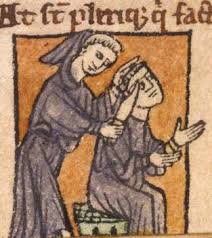
The Mortimers of Wigmore, held their lands from Domesday to the death of Richard III, a direct descendant of Anne, the last Mortimer heiress who died in 1411. The Mortimers of Wigmore gained lands by marrying significant heiresses such as Joan de Genville. She was the eldest of three girls. To improve her marriage prospects, her sisters were veiled at Aconbury Priory[19]. Joan brought the Mortimers lands and castles extending across Herefordshire and Shropshire.
Richard’s Castle passed through 4 or 5 families via female inheritances. Hugh Mortimer died in 1304 leaving two under age daughters, Margaret and Joan. His lands were divided equally between them[20]. However Rickard notes that the Talebots then held the Castle, but the IPMs for the de Cornwailes suggest they also held it.[21].
Monastic Lands
- Bromfield Priory, pre conquest house, joined with St Peter’s Abbey Gloucester in 1155[22].
- The Hospital of St John, Ludford, founded in c1220’s by a local burgess, Peter Undergod[23]
- Wigmore Abbey, founded by the Mortimers of Wigmore in 1179, having been moved from Shobdon and then Aymestry[24]
- A Nunnery at Lymbroke, 2 miles from Wigmore, founded during the reign of Richard I[25].
Significant Subtenants
The chief lords were supported by a complex web of tenants and sub-tenants, minor nobles, knights and the merchant elite. The extents of IPMs and Feet of Fines are currently being consulted to identify these men. It was common for them to hold lands and owe knight’s service to more than one chief lord. Some eventually were granted their lands in their own right, whilst others purchased land from neighbours and landlords when they fell on hard times.
Identification of Local Peasant and Mercantile Families
The IPMs, Feet of Fines, Muster Rolls and Manorial records will be used to identify significant families who did not have rank. These records will be used to gain an understanding of how these families interacted with their over lords and made use of the land and its resources.
Please Note: – At the end of the study a paper, with bibliography and glossary will be be made available in PDF format.
Next Post: Will identify communities and landholders at Domesday
References
[1] Rackham O (1976) Trees and Woodlands in the British Landscape. J.M. Dent and Sons. London p13
[2] Feet of Fines, Shropshire record CP 25/1/194/8, number 8. AND CP 25/2/294/9, number 41 [online] http://www.medievalgenealogy.org.uk/fines/abstracts/CP_25_1_194_8.shtml
[3] Lovelace D (2005, 2017) Bringewood Chase and Surrounding Countryside [online] http://www.bosci.net/iw/BringewoodReportDLJan2017.pdf Accessed 1.4.2018
[4] Grant (1991) The Royal Forests of England. Alan Sutton, Stroud P169-171
[5] Grant op cit p31-32. Manwood, J (1665) Manwood’s Treatise of the Forest Laws pp 49-50
[6] Grant op cit .p 4-5
[7] Lovelace op cit
[8] Rackham O (1981) Trees and Woodland in the British Landscape. J.M. Dent & Sons Ltd, London. P18-23_
[9] Morris S (2015) Shropshire Deer Parks C1500 – C1914, Recreation, Status and Husbandry. PhD Thesis University of East Anglia
[10] Forests and Chases of England and Wales, c1000 to c.1850. [Online] http://info.sjc.ox.ac.uk/forests/ accessed 25.6.2018
[11] https://www.kcl.ac.uk/artshums/depts/ddh/research/projects/completed/mapping.aspx
[12] Includes the Red and Black Books of the Exchequer, Charter, Chancery, Close and Fine Rolls, and Letters Patent
[13]Lovelace op cit p9.
[14] Palmer JJN. Open Domesday [Online] http://opendomesday.org/place/SO4273/downton-on-the-rock/ Accessed 25.6.2018
[15] Palmer JJN. Open Domesday [Online] http://opendomesday.org/place/SO4870/richards-castle/Accessed 25.6.2018
[16] Calendar of Inquisitions Post Mortem Volume I, Henry III. HMSO 1904. No 439
[17] Calendar of Inquisitions Post Mortem Volume V, Edward II. HMSO 1908. No 57.
[18]The Talebots held Richard’s Castle from 1305, although in what capacity is unclear.
[19] Cawley, Charles (2010). Medieval Lands, Champagne Nobility, Seigneurs de Joinville. Sourced from Dugdale Monasticon V, Tintern Abbey, Monmouthshire V, In Chronicis Abbatiae Tynterne in Wallia. p.270
[20] The Calendar of Close Rolls of Edward I volume V, Mackie & Co Ltd pp 285-6
[21] Rickard J (2002) The Castle Community: The Personnel of English and Welsh Castles 1272 – 1422. Boydell Press. Woodbridge. Pp 249 – 250
[22] M J Angold, G C Baugh, Marjorie M Chibnall, D C Cox, D T W Price, Margaret Tomlinson and B S Trinder. “Houses of Benedictine monks: Priory of Bromfield,” in A History of the County of Shropshire: Volume 2, ed. A T Gaydon and R B Pugh (London: Victoria County History, 1973), 27-29. British History Online, accessed June 25, 2018, http://www.british-history.ac.uk/vch/salop/vol2/pp27-29.
[23] Angold et al op cit pp 102-4
[24] Wright T (1852) The History of Ludlow and Its Neighbourhood, Forming a Popular Sketch of the History of the Welsh Border. Longman. p96
[25] Wright op cit p95 – 96


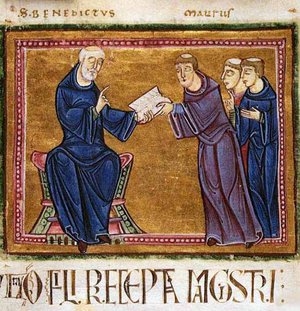
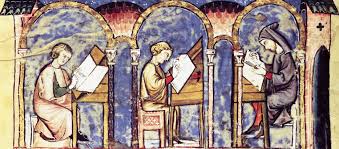 Monasteries were hubs of daily life, their spiritual and charitable aims drawing people in. Pilgrims sought out their miracle-working relics, a mainstay of popular religion. Abingdon had a large collection of relics, including those of St Vincent of Saragossa (5). The ‘Black Cross’ of Abingdon, was believed to have been fashioned from a nail of the True Cross.
  Revival and reform were important as monastic communities sometimes lost sight of their founding principles. New stricter orders such as the Cluniacs and Cistercians developed as a result, later experiencing similar problems. Despite the accusations of endemic corruption, at the Reformation, there is little historical evidence to support this claim. There were scandals, but they were very rare. A few religious houses could live in opulent idleness, but most were workaday communities. Period visitations from the Bishop or Archdeacon rooted out financial irregularities and inappropriate behaviour, and in extreme cases the Pope could remove an incompetent Abbot or Prior.

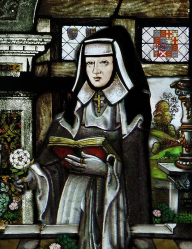
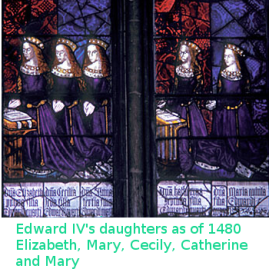
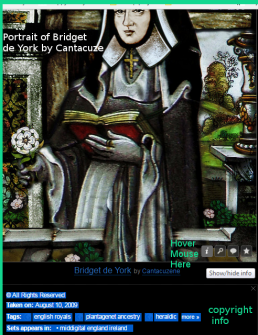 Now we have the source of the image, we need to find the following information: artists name, a date and the correct title for the image. Some sites do make this harder to find than others, which is where the problem with our painting of Bridget, might have arisen.


 Schiffmuhle by H Ernst 1805

